


Introduction to pension risk transfer
Defined benefit (DB) pension plans create liabilities that expose plan sponsors to risks such as longevity risk, investment risk and interest rate risk. To mitigate these risks, plan sponsors may transact future pension payment obligations with an insurance provider. Pension risk transfer (PRT) allows plan sponsors to offload pension plan liabilities and de-risk balance sheets.
By transferring pension obligations to an insurance company through the purchase of group annuity contracts (GACs), plan sponsors decrease balance sheet risk and liabilities, reduce administrative overhead, and eliminate obligations to the Pension Benefit Guaranty Corporation (PBGC). Insurers take on the responsibility for making future benefit payments in exchange for an upfront premium from the plan sponsor. The following are the article’s main findings:
| ► PRT activity is booming, driven by economic conditions and pension de-risking strategies.
► Litigation is increasing, with plaintiffs challenging whether transfers improperly expose retirees to additional risk. ► Economic damages analysis is central to these cases, particularly around transaction spreads, cost savings, and the value of lost protections. |
Over the past several years, there has been a sharp uptick in PRT activity. In 2024, there were 785 PRT transactions totaling $51.8 billion in premium, approximately twice the $26.9 billion in 2020.1 Greater market volatility, higher interest rates, and a shift toward pension de-risking, have been the driving factors behind PRT activity. Higher interest rates reduce the present value of pension liabilities, making the cost of transferring liabilities favorable for plan sponsors. Strong equity markets also contribute, as improved asset performance can strengthen a DB plan’s funded status and create favorable conditions for plan sponsors to offload liabilities. At the same time, increased competition among insurers drives competitive pricing.2
Summary of PRT litigation status
The rise in PRT is accompanied by a corresponding rise in PRT litigation, often in the form of class action litigation initiated by plan participants against plan sponsors and fiduciaries. Broadly, these lawsuits claim that pension obligations have been transferred to risky annuity providers. Plaintiffs seek financial relief resulting from the profits and cost savings accrued by plan sponsors through PRT, as well as compensation for the increased risk that they will not receive the benefit payments to which they are entitled, and a decrease in value of their pension benefits due to uncompensated risk. Plaintiffs have also sought injunctions to receive their benefits promised under the plan.3
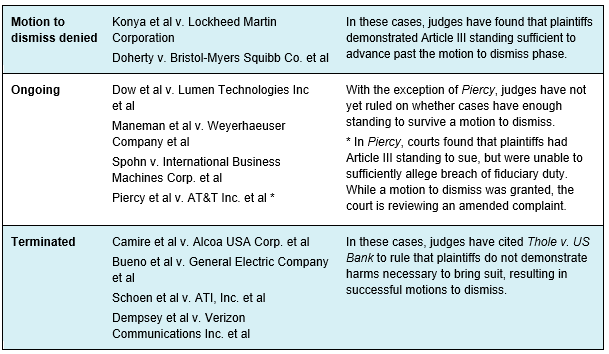
The following table summarizes the status of PRT lawsuits. The split in decisions across current PRT litigation illustrates the unsettled nature of the legal landscape and may embolden other plan participants to bring similar litigation against plan sponsors.
Table 1: Status of recent PRT lawsuits4
Damages sought
The damage sought in PRT litigation generally falls into (A) benefits to plan sponsors from PRT and (B) monetary losses to plan participants from PRT. At its core, the damages dispute is centered around the transaction spread, along with PBGC premium savings, administrative cost reductions, and the value of the federal protections participants forgo.
Benefits to plan sponsors
Transaction spread
Plan sponsors benefit when the spread between the valuation of the transferred liabilities and the premiums paid for the group annuity contract is positive. This spread reflects the insurer’s willingness to accept the obligation at a discount relative to the plan sponsor’s book value. Plaintiffs argue that this discount comes at the expense of plan participants.
In Dempsey et al v. Verizon Communications Inc. et al, Verizon’s pension plans purchased group annuity contracts from The Prudential Insurance Company of America (PICA) and RGA Reinsurance Company. Under the PRT transaction, approximately 56,000 retirees were transferred from Verizon’s pension plans to annuity contracts issued by PICA and RGA. In exchange for assuming responsibility for future pension payments to the affected retirees, PICA valued its liabilities to the impacted retirees at $5.9 billion. Yet Verizon only transferred approximately $5.7 billion of pension plan assets to PICA and RGA to fund the purchase of the GACs.
Plaintiffs alleged that Verizon recognized approximately $200 million in immediate pre-tax profit arising from the difference between PICA’s valuation of liabilities at $5.9 billion and Verizon’s purchase of the GACs for approximately $5.7 billion. In other words, the PRT reduced Verizon’s liabilities by $200 million more than it would reduce its assets, which plaintiffs interpret as constituting a profit. Plaintiffs questioned why PICA took $200 million less from Verizon to cover pension liabilities. They believed that PICA’s offloading of liabilities to wholly owned captives and affiliates, and State Street’s (the independent fiduciary in this case) complicity and conflicts of interest, were credible explanations for what appeared to be otherwise entirely inconsistent and irreconcilable transactions.
In Piercy et al v. AT&T Inc. et al, the complaint alleged an immediate profit of $363 million attributable to a comparable dynamic.
Administrative cost savings
Following a PRT, plan sponsors are no longer responsible for the ongoing administration of operating a defined benefit plan, including actuarial services, investment management, legal compliance, plan administration, and participant communication. The Piercy et al v. AT&T Inc. et al complaint estimated that AT&T would save between $90 million and $180 million in administrative costs.
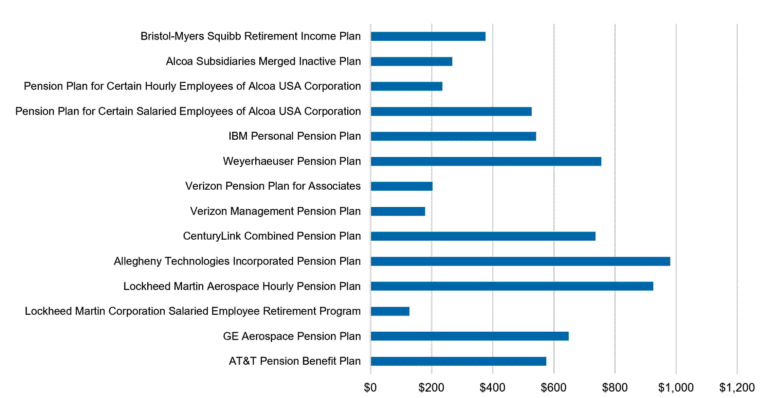
Figure 1 presents the administrative cost per participant for the pension funds for the cases presented in Table 1. Over the five years preceding and including the filing of the complaint, the average administrative cost per participant for these funds ranged from $128 to $980.5
Figure 1: Average administrative cost per participant
PBGC premium savings
Plan sponsors are required to pay annual flat-rate and variable-rate premiums to PBGC to insure their pension obligations against a potential default for as long as they maintain a defined benefit plan. Upon completing a PRT, these premium obligations cease entirely as a PRT removes PBGC protections. The Piercy v AT&T complaint estimated $182 million in savings from PBGC flat-rate premiums that AT&T would no longer be required to pay.6
Monetary losses to plan participants
Incremental risk and reduced annuity value
Plaintiffs allege that plan participants bear additional financial risk as a result of the PRT. For example, in Camire et al v. Alcoa USA Corp. et al, plaintiffs quantify this incremental risk using Athene’s bond risk premium, measured as the spread between Athene’s credit-implied cost of debt and the risk-free rate (approximately 21.4% at the time of filing).7 In Bueno et al v. General Electric Company et al and Maneman et al v. Weyerhaeuser Company et al, compensation is sought for the difference between the value of the annuity actually purchased (from Athene) and the value of the “safest available” annuity that the Department of Labor’s Interpretive IB 95-1 requires fiduciaries to obtain.
Value of lost federal protections
The value of ERISA and PBGC protections forgone by plan participants is also at issue. PBGC coverage effectively guarantees benefits against pension plan default. If the PBGC takes over a plan, it typically provides monthly benefits for life, subject to a maximum guarantee.8 For example, the PBGC maximum monthly guarantee for a single-employer pension plan (straight-life annuity) in 2026 is $1,947.44 for a participant who begins receiving benefits at age 45, $7,789.77 at age 65, and $23,680.90 at age 75.9 After a PRT, the pension benefits are no longer protected by the PBGC. Instead, insurance annuities are covered by state guaranty associations (SGA), which provide protection if insurance companies fail.
In most states, SGA’s coverage of an individual policy is $250,000 in present value of annuity benefits, including net cash surrender/withdrawal values, and any benefits above that level may be funded from the failed insurance company’s remaining assets.10
A report by the National Organization of Life and Health Insurance Guaranty Associations comparing PBGC and state guaranty coverage systems concludes that both frameworks protect the majority of benefit claims in the event of payer insolvency. For the smaller subset of individuals who are not fully covered, the relative level of protection between the two systems may vary depending on the specific circumstances of a given insolvency.11
Conclusion
The recent wave of PRT litigation reflects an unsettled and evolving landscape. Claims regarding alleged damage commonly rely on quantifying transaction spread, PBGC premium savings, administrative cost reductions, and the value of foregone federal protections, all of which require rigorous analysis of annuity valuation, insurer solvency, and regulatory guarantees.
CRA has longstanding experience supporting litigation involving pension sponsors and insurance companies, and is well positioned to address the key economic, risk, and valuation issues central to PRT disputes.
1. Aon, “U.S. Pension Risk Transfer Update – 2024 Year In Review and Future Expectations,” February 2025, https://www.aon.com/en/insights/reports/us-pension-risk-transfer-update.
2. MetLife, 2025 Pension Risk Transfer Poll, Paul Mulholland, “Market Volatility, Interest Rates Driving PRT Growth,” October 9, 2025, https://www.psca.org/news/psca-news/2025/10/market-volatility-interest-rates-driving-prt-growth/. Aon, “U.S. Pension Risk Transfer Update – 2024 Year In Review and Future Expectations,” February 2025, https://www.aon.com/en/insights/reports/us-pension-risk-transfer-update.
3. Grace Elletson, “AT&T Offloaded Pensions in Risky Annuity Deal, Suit Says,” Law360, March 12, 2024, https://www.law360.com/articles/1812646/at-t-offloaded-pensions-in-risky-annuity-deal-suit-says. See, e.g., Camire et al. v. Alcoa USA Corp et al., Complaint, dated April 12, 2024, pp. 48, 50.
4. We identified from Lex Machina PRT Cases from a set of all federal class action cases filed between January 1, 2024 and March 27, 2026.
5. Calculation based on data collected from Form 5500 filings.
6. Pension Benefit Guaranty Corporation, “Premium Rates,” October 27, 2025, https://www.pbgc.gov/employers-practitioners/premium-filings/rates. For plan year 2026. The per-participant flat-rate premium for single-employer plans is $111. The variable-rate premium (VRP) for single-employer plans remains at $52.00 per $1,000.00 of unfunded vested benefits. the VRP per participant is capped at $751.
7. Camire et al. v. Alcoa USA Corp et al., Complaint, dated April 12, 2024, p. 31.
8. Pension Benefit Guaranty Corporation, “Annuity or Lump Sum,” March 13, 2026, https://www.pbgc.gov/workers-retirees/learn/annuity-lump-sum.
9. Pension Benefit Guaranty Corporation, “Maximum Monthly Guarantee Tables,” October 30, 2025, https://www.pbgc.gov/workers-retirees/learn/guaranteed-benefits/monthly-maximum.
10. National Organization of Life & Health Insurance Guaranty Associations, “FAQs: General Info,” https://nolhga.com/policyholders/frequently-asked-questions/; In addition, there is usually a $300,000 overall cap for any particular individual with multiple policies with the insolvent insurer: American Council of Life Insurers, “Guaranty Associations,” https://www.acli.com/about-the-industry/guaranty-associations#OLE_LINK1. There is variation across states. For example, as of 2025, California covers only 80% of annuity benefits up to $250,000, whereas New York provides coverage up to $500,000: California Life & Health Insurance Guarantee Association, “Frequently Asked Questions,” https://www.califega.org/FAQ; The Life and Health Insurance Company Guaranty Corporation of New York, “Frequently Asked Questions,” https://www.nylifega.org/FAQ/Print.
11. National Organization of Life & Health Insurance Guaranty Associations, “Consumer Protection Comparison: The Federal Pension System and the State Insurance System,” May 22, 2026, https://www.athene.com/binaries/content/assets/ausa-assets/advocacy/national-organization-of-life-and-health-insurance-guaranty-associations_pension-report.pdf, p.38.
