


The closing panel from the 2025 CRA Brussels Conference, “Digital Regulation in Action: The DMA, AI, and the Future of Competition” moderated by Dr Matteo Foschi, brought together prominent European regulators and leading academics to examine the evolving landscape of digital regulation, contrasting the EU’s proactive approach under the Digital Markets Act (DMA) with the United States’ reliance on traditional antitrust enforcement.
The panel explored the interplay between ex ante regulation and ex post enforcement, the challenges of implementing effective remedies in fast-moving digital markets and the potential consequences for innovation. It also delved into emerging competition concerns in artificial intelligence, highlighting differing perspectives on regulatory intervention, market power and the future direction of global tech governance.
Key takeaways from the session
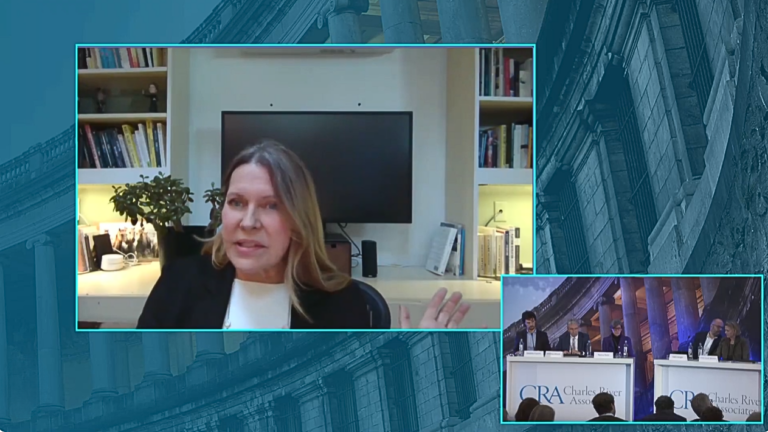
The panel consisted of senior European enforcers Andreas Mundt (President, Bundeskartellamt) and Dr Hans Zenger (Head of Unit, Chief Economist Team, DG Competition, European Commission) as well as academics Professor Fiona Scott Morton (Theodore Nierenberg Professor of Economics; Yale School of Management, Senior Consultant to CRA), Professor Nancy Rose (Charles P. Kindleberger Professor of Applied Economics, Massachusetts Institute of Technology) and Professor Melissa Schilling (Professor of Management, NYU Stern School of Business).
To set the scene, Dr Foschi reminded the audience that four years into the implementation of the Digital Markets Act (DMA), the European Commission (EC) has already opened six non-compliance cases, with two non-compliance decisions, and launched three new designations investigations in the cloud sector earlier in November. By contrast, the United States has taken a different approach to regulating tech, relying largely on traditional antitrust theories and reviving older cases, such as the Meta monopolization trail, rather than introducing a comprehensive ex ante regulatory framework. Both jurisdictions are grappling with the same fundamental controversy: whether competition concerns in digital markets are better addressed through ex ante regulation to prevent abuses, or through ex post enforcement of abuses?
Ex ante regulation in Europe
To shed light on this question, Dr Foschi asked the panellists for their perspectives on the intersections between ex ante regulation and ex post enforcement of Article 102 in Europe.
Andreas Mundt began the discussion by providing a status update on the enforcement of “Section 19a” in Germany, Europe’s unique national ex ante competition regulation regime, under which five gatekeepers have already been designated. President Mundt noted that while the provision has faced intense domestic lobbying, it has nonetheless produced a series of important cases. These include the ongoing investigation into Apple’s App Tracking Transparency framework, which required coordination with other European national enforcers, and in which Apple’s proposed commitments are currently being market tested. Another example is the Bundeskartellamt’s commitment decision related to Google’s automotive services, where, according to President Mundt, early intervention helped prevent market tipping and led to worldwide unbundling of Google’s solution. President Mundt noted that a key advantage of Section 19a is its procedural speed, as decisions can only be appealed once, enabling faster enforcement.

Professor Fiona Scott Morton continued the discussion with the implementation of ex ante regulation in Europe and how this would interact with the use of Article 102 moving forward. According to Professor Scott Morton, ex ante regulation in the EU is still in a “start-up mode”. She noted that the challenges faced by the DMA regarding speed and legal certainty, considering DG Competition’s limited enforcement resources and lengthy appeals. She also noted that geopolitical considerations, notably the war in Ukraine, were increasingly interfering with the DMA’s implementation.
Looking ahead, Professor Scott Morton stressed the role that businesses, civil society and national judges might increasingly play during this early phase, noting how private enforcement and injunctive relief decisions may constitute powerful tools to spur innovation in digital markets. Continued enforcement of Article 102 Treaty on the Functioning of the European Union (TFEU) will also remain an essential complement to the DMA, providing additional deterrence through follow-on damages claims. Professor Scott Morton also pointed to the Epic Games cases against Apple and Google in the United States as a source of important lessons on remedies, noting that measures ordered by the courts on e.g. side-loading and app store fees could have global effects and unlock substantial innovation opportunities.

Building further on the fine line between the DMA implementation and Article 102 enforcement, Dr Hans Zenger focussed on the design of remedies in the recent Microsoft Teams Decisions. Dr Zenger reminded the audience of the inception of the Microsoft Teams case during the Covid-19 pandemic, when demand for online collaboration tools surged and Microsoft bundled Teams with its broader productivity suite. Dr Zenger raised the question of how DG Competition should respond in future cases in which firms would not offer unbundling as a remedy, noting the challenges of designing effective price-based remedies in digital markets characterized by zero prices and network effects. He argued that Article 102’s notion of “special responsibility” for dominant firms fits cases like Microsoft Teams particularly well, as ensuring fair opportunities for rivals is crucial.
Perspectives from the United States
Moving away from Europe, Dr Foschi asked the panellists for their perceptions of the United States’ ability to enforce competition laws without an ex ante regulation mechanism.
Professor Nancy Rose initiated the discussion with a status update on the key digital competition cases in the US. She observed that the United States was late to confront competition issues in the tech sector but had now caught up to other regions through enforcement efforts spanning the Trump and Biden administrations as well as State Attorneys General, leading to strong judgments on liability. Professor Rose recognised that deterrence remains weak however due to long enforcement timelines, fostering a culture in which companies tend to “ask for forgiveness, not permission”. She illustrated these mixed outcomes based on several recent judgments. According to Professor Rose, the Google Ad Tech Decision offers promising principles on remedies, though their practical implementation remains uncertain. On the other hand, she also pointed out how the FTC v. Meta judgment revealed serious analytical flaws, including reliance on experiments that did not reflect real market conditions.

Professor Melissa Schilling offered contrasting views on the potentially adverse effects of regulation on innovation. Professor Schilling framed the debate on digital regulation as a tension between the rule of law, embodied in bright-line rules, and the rule of reason. She stressed that the “harm” of regulation on businesses is not always easy to identify, as some regulatory obligations may be disproportionately costly for smaller firms, effectively creating barriers to entry. Professor Shilling also noted how other rules may increase complexity for businesses, although certain elements, such as the DMA’s turnover thresholds, can provide welcomed clarity. More fundamentally, she argued, some regulations may constrain firms’ core business models, as illustrated by interoperability requirements affecting Amazon’s fulfilment practices or restrictions on Apple’s tightly integrated ecosystem, which has been central to its value proposition since inception.
Testing the panellists’ appetite for ex ante regulation
To conclude this exchange on ex ante regulation and ex post enforcement, Dr Foschi asked the panellists to rate their preference for ex ante regulation on a scale from 1 (strong preference for ex ante regulation) to 5 (strong preference for ex post enforcement).
Panellists expressed varying degrees of scepticism. Contrasting Professor Schilling’s rating of 2–3, President Mundt stressed that not all regulation is the same, warning that the EU often over-regulates and risks an “innovation infarct”, citing GDPR’s disproportionate impact on small firms and the excessive burden of the AI Act. By contrast, he praised the DMA as good regulation rooted in competition practice rather than bureaucracy, giving it a score of 1, while assigning the AI Act a 5. Professor Scott Morton agreed with President Mundt’s rating, arguing that AI is akin to electricity and extremely difficult to regulate ex ante. Dr Zenger gave a score of 2, emphasizing that fixed compliance costs hit small firms hardest and that digital regulation is inherently more complex than regulation in legacy sectors. Professor Rose rated her support at 2.5, favouring targeted, incentive-based regulation for large firms and expressing scepticism toward structural, utility-style regulation in digital markets.

Competition concerns in AI
To conclude the discussion, all panellists were asked about their views regarding market developments in AI, notably the investment race currently at play between major players with no monetization strategy, or ROI, in sight.
President Mundt first argued that early monetization is less important than the accumulation of power and the ability of firms to shape future rules through investments, drawing parallels with Amazon’s early growth. He expressed particular concern about the unprecedented concentration of global AI infrastructure (cloud services and data access) in the hands of just three firms. Dr Zenger took a more optimistic view, describing AI market developments as exciting, due to the ongoing uncertainty about the nature of AI’s competitive moats. He noted that AI models may not benefit from strong network effects and could become commoditized, making distribution a key competitive lever.
Dr Zenger and Professor Schilling both stressed the importance of AI’s impact on access to online content. Dr Zenger noted that Google’s AI overviews might make future content creation more difficult, raising concerns about vertical integration and exclusivity deals. Earlier in the day, Executive Vice President Teresa Ribera had announced during a live stream from the conference, the opening of an EC investigation into Google’s AI overview. Professor Schilling highlighted the potentially severe impact of AI on copyright, pointing to lawsuits against Perplexity and Anthropic over data ingestion. She noted how, depending on judicial outcomes, AI could make it easy to duplicate or adapt content, potentially undermining the role of exclusivities.
To conclude, Professor Scott Morton suggested that AI-related risks may be better addressed through consumer protection laws, particularly in areas like online shopping where AI-generated responses are likely to become monetized, steering users toward specific products. Professor Rose expressed limited concern about the current lack of profitability among large AI firms but warned against the erosion of the rule of law in the US, especially if federal legislation were to pre-empt state-level AI regulation.
CRA will continue to provide economic analysis and strategic guidance as these policies evolve.
