MFN-related uncertainty is reshaping pharmaceutical launch planning by making pricing, sequencing, and forecasting decisions more interconnected and consequential across markets. To protect long-term value, manufacturers need earlier and more integrated collaboration across commercial, market access, pricing, forecasting, and policy teams.
Key points
- Launch pricing should be treated as a long-term, multi-market commitment because early decisions may influence future negotiations and US revenue exposure.
- Launch sequencing has re-emerged as a strategic value-management lever that must account for reference pricing dynamics, market interdependencies, and evolving policy risks.
- Flexible, scenario-based forecasting and cross-functional planning are essential for building launch strategies that remain resilient under multiple future policy scenarios.
Rethinking launch strategy in the MFN era
For decades, commercial launch planning followed a familiar playbook. Pharmaceutical manufacturers typically prioritized launches in high-opportunity, premium-price markets before expanding into more price-constrained, volume-dependent geographies. The underlying assumptions were straightforward: pricing interdependencies across markets were relatively predictable, launch sequencing could be optimized over time, and historical experience provided a reliable guide for future decisions.
Today, those assumptions are being challenged, primarily due to the introduction of the Most-Favored-Nation (MFN) pricing models that have brought a new level of uncertainty into the global pricing environment. Whether through direct international reference pricing mechanisms, evolving policy proposals, or future regulatory adaptations, the possibility that ex-US pricing decisions could have a more substantial impact on US pricing has fundamentally altered how manufacturers must think about launch strategy. At the same time, greater cross-country collaboration and heightened scrutiny of drug pricing are creating a world where pricing decisions made early in a product’s lifecycle can have consequences that extend far beyond a single market or region.
In these uncertain times, organizations need to consider how launch decisions are being made, including who makes these decisions and when. Market sequencing decisions that once appeared rational and durable can quickly become exposed to new policy and pricing consequences before they are ever fully executed. The launch blueprint that commercial organizations have relied upon for years needs to be rewritten.
Whether for a large multinational pharmaceutical company or an emerging biotech preparing for its first launch, future success will increasingly depend on early and deliberate coordination among stakeholders in the commercial, pricing, market access, forecasting, and policy teams. Amid ongoing uncertainty, cross-functional integration is a strategic imperative.
Launch pricing is a long-term commitment
Previously, launch pricing afforded manufacturers with a certain degree of strategic flexibility. International reference pricing (IRP) has always been a launch consideration, but pricing decisions could be optimized from one market to the next as manufacturers balanced local market dynamics against their broad global objectives.
Given the significance of the US market and the potential ramifications of MFN, however, companies now have substantially less pricing flexibility across countries. Once a price is set in one market, it becomes a reference point that other markets will negotiate against, whether through formal external reference pricing mechanisms or informal payer benchmarking. The implications of these dynamics are amplified by the proposed MFN-based price referencing models (i.e., GLOBE, GUARD, and GENEROUS), all of which potentially expand the influence of IRP decisions to US revenues.
The challenge for launch teams is not only understanding and planning around the mechanisms of these MFN models, but also on managing the uncertainty surrounding how they may be ultimately implemented, interpreted, and even modified over time. If a strategy that appears to avoid the intent of MFN rules becomes too popular and effective, we would expect that policies will adapt. Further complicating the landscape is the reality that pharmaceutical pricing reform remains a bipartisan area of focus in the US, even though future administrations may pursue different approaches. Some US policy pathways emphasize international reference pricing, while others may seek to expand domestic pricing controls, health technology assessment processes, or Inflation Reduction Act-related negotiations (see figure 1).
Figure 1: Potential pricing policy by US political party
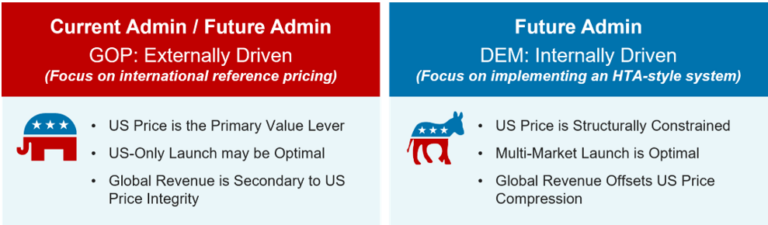
For commercial teams, this creates a planning environment in which future rules remain uncertain, yet the consequences of today’s decisions remain very real. A launch price that appears commercially attractive in the near term may ultimately influence pricing negotiations across multiple future geographies. Similarly, a change in reference market composition could unexpectedly elevate the significance of decisions made years earlier.
As a result, launch pricing needs to be viewed as a multi-year, multi-market commitment with potentially irreversible consequences. While future policy direction may remain uncertain, the need for disciplined decision-making today has never been more important.
Launch sequencing is a strategic value management lever
Launch order has traditionally been optimized around market opportunity, regulatory timelines, reimbursement pathways, and organizational readiness. While those factors remain critical, sequencing decisions now carry broader strategic implications. In a world influenced by international reference pricing dynamics, launch order can directly affect future pricing flexibility and long-term revenues. It is important to evaluate markets not only on their own revenue potential, but also on their influence on other markets and how that impact may evolve as policy changes.
This requires organizations to expand the set of variables that inform launch pricing and sequencing decisions. Factors such as willingness-to-pay, reimbursement potential, international reference pricing influence, indication scope, evidence requirements, launch complexity, time-to-access, and organizational readiness must be evaluated through a more integrated lens. As a result, launch sequencing is evolving from an executional activity into a strategic long-term value-management decision.
In some cases, manufacturers have decided to forego launching in historically important geographies to preserve value in others. Simultaneously, they’re also considering two other issues:
- How to increase value in price-constrained markets to eventually bring the drug to market globally; and
- Sharpening the view on revenues expected from smaller markets that may not have traditionally been prioritized.
The traditional playbook is no longer sufficient. Launch sequencing is now one of the most powerful levers available to manufacturers seeking to manage pricing risk and value in an increasingly interconnected global market.
Flexible scenario-based forecasting is core to strategic planning
One of the more underappreciated consequences of MFN-related uncertainty is the impact on forecasting. Traditionally, commercial forecasts have been designed to model uncertainties such as competitive entry, epidemiological shifts, access barriers, and uptake dynamics. These models help organizations understand potential future performance under a variety of market conditions. Most forecasting approaches, however, share a common assumption that the pricing environment itself remains relatively stable.
In an MFN-influenced environment, launch decisions, combined with an uncertain political landscape, can reshape the future pricing conditions against which commercial forecasts are built. Forecasts now need to be flexible enough to address a wide range of “what-if” questions around the implementation of MFN models and their integration with launch pricing and sequencing.
From a commercial strategy perspective, this launch and revenue uncertainty is not just a forecasting challenge; it is also a resourcing and organizational design challenge. Launch investment decisions, including market entry, field force sizing, market access allocation, and promotional spend, are typically built around a robust forecast and revenue trajectory. Without that foundation, it becomes harder to commit to markets when launch sequencing continues to shift.
In light of the potential risks of the future, commercial teams need a clear view of where they can succeed with the capabilities and resources available in today’s volatile landscape. In this context, archetyping across a broader-than-usual set of countries, combined with careful environmental monitoring by cross-functional teams, becomes a core element of the planning process and is critical to enabling a more flexible launch planning approach. Flexible, scenario-based forecasting, supported by adaptive pricing frameworks and assumptions, can play a vital role in quickly integrating viewpoints across these teams, leading to an optimal launch sequencing strategy.
The case for integrated commercial and market access strategy
As pricing decisions, launch sequencing, and reimbursement outcomes become more interconnected, deeper integration across commercial, market access, and pricing teams is essential. Early, integrated planning enables organizations to move beyond reviewing individual market opportunities in isolation and consider how singular decisions may have broader global repercussions.
The key questions are no longer:
- Which market should launch first?
- How much revenue can we generate at peak?
- How quickly can we secure reimbursement?
Instead, organizations should ask:
- Which launch pathway maximizes long-term global value?
- How will pricing decisions in one market influence future opportunities elsewhere?
- What launch sequencing strategy best balances revenue generation, access goals, and pricing flexibility?
- How can we build launch plans that remain resilient across multiple future policy scenarios?
The companies best positioned for success will be those that treat commercial strategy, pricing, market access, and forecasting as interconnected disciplines rather than separate functions operating in sequence, or worse, independently.
Conclusion
In a rapidly changing environment, brand teams launching drugs need to rethink their approach, as the traditional launch blueprint no longer applies.
Instead, a more integrated model needs to emerge where launch decisions are evaluated through a shared lens of long-term value creation: pricing decisions are harder to reverse; launch sequencing is a strategic value-management lever; and forecasting is increasingly dependent on decisions that shape the pricing environment itself.
Organizations that continue to view market access and pricing as downstream execution capabilities may find themselves reacting to unintended consequences. Those that integrate commercial, market access, pricing, and forecasting considerations from the outset will be better positioned to navigate uncertainty, protect pricing flexibility, and maximize long-term value.
In the MFN era, cross-functional integration is no longer simply a best practice, it is an operational requirement.