


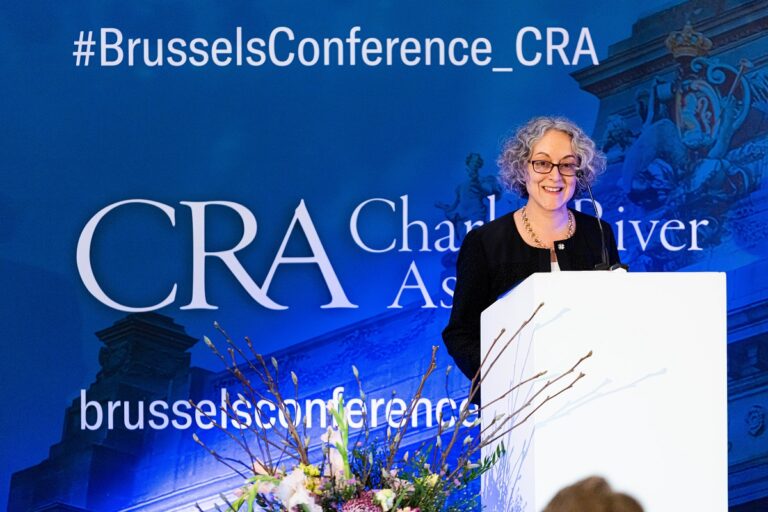
CRA Vice President Dr Philip Kalmus hosted a panel “The Interplay of Law and Economics at the EU General Court and the UK Competition Appeal Tribunal” with Mrs Justice Kelyn Bacon DBE, Judge at the High Court of England and Wales and President of the UK Competition Appeal Tribunal, and Judge Marc van der Woude, President of the General Court at the European Court of Justice, to discuss the interplay of law and economics at the European General Court (EGC) and the Competition Appeal Tribunal (CAT).
From economic analysis to ethical standards in competition law
Judge van der Woude shared his view that the era of the “more economic approach” is past its peak, and a new era of a “more ethical approach” is on the horizon. He recapped how competition cases have evolved from the early days in the 60s when a very formalistic approach was applied, over a transition phase in the 80s and 90s to finally enter an era of the “more economic approach”. But jurisprudence is in flux and Judge van der Woude has observed a shift towards a “more ethical approach”, exemplified by various changes:
First, due to enforcement issues in the context of big tech, the Digital Markets Act (DMA) and Digital Services Act (DSA) have been adopted, which seem reminiscent of the old formalistic world. Second, economic concepts are becoming less important in court cases. For instance, the As-Efficient Competitor Test (AECT) or the Small but Significant and Non-transitory Increase in Price (SSNIP) test are no longer imperative but considered merely optional today. Third, more emphasis is now placed on the “by object” than “by effect” restrictions, even in the application of Article 102. And most notably, the language used in judgments is characterised as more ethical in nature, referring to concepts that appear more normative than economic, such as “fairness” and “competition on the merits”. While economics will continue to be used in competition cases, its overall importance may recede.

Judicial critique of expert economic evidence
Mrs Justice Bacon DBE offered insights into the economic expert evidence put forward by claimants in two recent competition cases in the UK that fell short of convincing the courts of a damage.
Cabo Concepts v. MGM
Within the toy market, in Cabo Concepts v. MGM, the new entrant, Cabo Concepts, alleged that the established firm, MGM, had marginalised its presence by issuing an ultimatum to retailers: they were required to choose exclusively between selling MGM’s product or Cabo Concepts’ product, with the majority opting to stock the incumbent’s offering.
While the High Court found that MGM did abuse a dominant position in setting such an ultimatum, the claimant’s economist estimated damages based on a purely hypothetical scenario of the amount of money Cabo Concepts could have earned if they had become successful in selling their product, without investigating whether such a success was likely. The claim was rejected as the Court was not convinced that Cabo Concepts would have been successful and did not find the economic evidence helpful in determining whether it would have been.
Stellantis v. Autoliv
In the case of Stellantis v. Autoliv concerning occupant safety systems (OSS) for cars, the Original Equipment Manufacturer (OEM) alleged its supplier of having formed a cartel with other OSS suppliers to the detriment of Stellantis. The CAT ultimately did not award damages because it found the claimant’s economic expert’s quantification analysis was inconsistently specified across the product groups without sound explanation or robustness. Reasonable adjustments to the claimant’s regression model gave rise to vastly different results and it was not possible to determine which approach would be accurate.
In summary, Mrs Justice Bacon DBE emphasised that hypothetical models that are not grounded in facts and empirical models that are fragile and insufficiently robust are unlikely to be helpful economic evidence.

CRA will continue to provide economic analysis and strategic guidance as these policies evolve.
