
Following Executive Vice President Teresa Ribera’s keynote address and Guillaume Loriot’s remarks during the Spotlight on Merger Guidelines, the panel “All Points of the Compass: Navigating the Future of EU Merger Control” discussed the review of the European Commission (EU) merger guidelines, launched on May 8, 2025.
Panelists explored the complexities and challenges of updating the guidelines to address dynamic market realities, the need for clear and robust evidentiary frameworks, and the importance of balancing effectiveness with legal certainty. The session highlighted a shared commitment to guidelines grounded in sound economic principles, with particular attention to innovation, efficiencies, and the evolving geo-economic landscape.
The panel was moderated by Dr Oliver Latham (CRA) and featured Daniele Calisti (Head of Unit, DG Comp), Elisabetta Iossa (Commissioner of the Italian Competition Authority), Damien Gerard (Prosecutor General of the Belgian Competition Authority), Ted Rosenbaum (Acting Director of the Bureau of Economics at the US Federal Trade Commission) and Fernando Castillo de la Torre (Head of the Competition team of the Legal Service, European Commission).
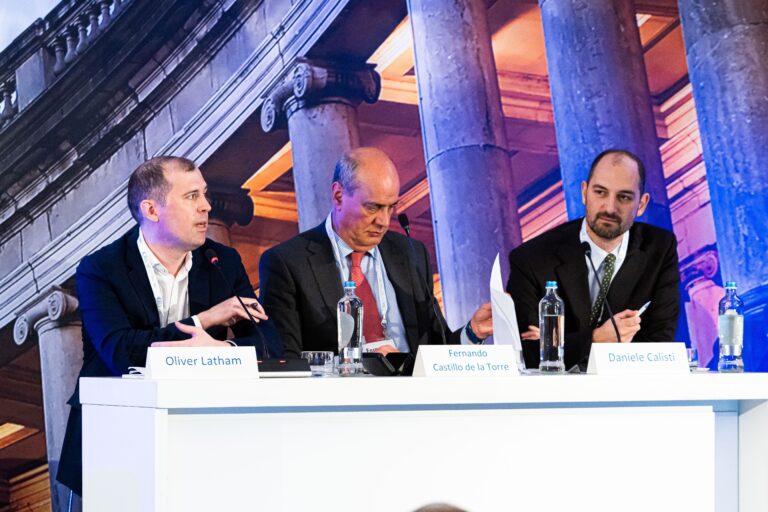
Charting the course: The commission’s perspective
Daniele Calisti shared insights into four topics of the EU’s Competitiveness Compass: scale, resilience, metrics for market power, and innovation.
Scale: Calisti addressed the public debate on scale, noting that the consultation received an unprecedented number of responses. He observed that, while some stakeholders argue merger control should be more lenient to allow European firms to compete globally, SMEs often fear that consolidation among upstream suppliers will make them less competitive.
Calisti clarified that the merger regulation is neutral regarding scale, with no embedded bias against it and no “efficiency offense”. Rather, the new guidelines aim to provide positive guidance on when transactions can benefit competitiveness and the Single Market.
Resilience: Calisti highlighted a semantic divide in the feedback from the consultation. Some view resilience as being big enough to withstand shocks, while others view it as having enough alternatives to survive them. The challenge for the Commission is to reconcile these views and adopt guidelines that advance resilience in the Single Market.
Metrics for market power: Calisti also touched on metrics for market power, offering reassurance against the fear that these metrics would become rigid presumptions. He pointed out that the Commission primarily uses metrics to dispose of cases quickly via the simplified procedure, with over 90% of cases cleared on this basis. However, he acknowledged that in complex cases, metrics are just the starting point for discussing market power, not the end of the analysis.
Innovation: Calisti acknowledged the need to codify more dynamic theories of harm and look at dynamic counterfactuals with longer time horizons. However, he proposed to balance this approach with an “Innovation Shield”—essentially a safe harbour or dynamic equivalent—to ensure that the new rules do not inadvertently stifle transactions in innovative spaces unlikely to raise concerns.

The innovation imperative
A significant portion of the panel was dedicated to dynamic theories of harm and innovation.
Elisabetta Iossa offered an academic and regulatory perspective. Referencing the Draghi report and the productivity gap in Europe, she argued that competition is not an obstacle but a driver of innovation and competitiveness. Other tools, such as R&D subsidies, tax credits, research grants and procurement in innovation, are better positioned to address the competitiveness gap than competition policy.
Iossa pointed out that there is no evidence of overenforcement in merger policy, as very few transactions ever reach Phase II and even fewer are blocked. If anything, empirical literature has found evidence of underenforcement in both Europe and the US.
Drawing on her experience as a regulator, Iossa argued that there is sufficient flexibility in the current merger guidelines to consider non-price effects. Merger control must also remain vigilant against the acquisition of nascent competitors. She shared the Italian authority’s experience with “call-in powers” for below-threshold mergers, noting that these powers are essential for reviewing acquisitions that might otherwise escape scrutiny.
Turning to economic theory. Iossa pointed out that, absent synergies, horizontal mergers are expected to reduce innovation incentives, as the negative effects of the loss of innovation rivalry outweigh any positive impact of higher margins on innovation incentives. However, synergies may be present that could shift the balance, and agencies have a duty to consider them. Mergers can also increase innovation by providing an exit strategy for start-ups (innovation for buyout).
Given these opposing effects, guidance may be welcome to disentangle economic effects that point in different directions.

Ted Rosenbaum provided a view from across the Atlantic, sharing lessons from the US FTC’s recent guideline refresh. He advised that while innovation can seem abstract, the analytical framework remains consistent: agencies must look at how incentives change (e.g., the incentive to steal share via innovation) and how capabilities change (efficiencies). Ultimately, his view was that the competitive effects of mergers on innovation were closely related to their effects on prices, such that the insights from traditional economic analysis largely read across.
He emphasised that claims of innovation efficiencies require rigorous scrutiny—specifically regarding merger specificity and whether promises will actually materialise.

Efficiencies and the “agility” gap
Damien Gerard brought a critical perspective to the debate on competitiveness and the Draghi report. He cautioned against rushing the guidelines, noting that 20 years of experience should not be overturned lightly and that the revised guidelines should instead integrate that experience fully.
Gerard argued that, while the Draghi report narrowly defines the lack of competitiveness of the EU economy as a productivity gap with the US/China, the solution is not necessarily a new analytical framework, but rather a change in regulatory agility (i.e., “operational practices” in Draghi’s terms). He posited that the current “three pillars” of efficiency assessment (consumer benefit, merger specificity, verifiability) remain sound. But there is undue caution embedded in the current wording, which suggests that efficiencies are unlikely to materialise.
Gerard advocated for openness toward dynamic efficiencies. He suggested that authorities need to be willing to consider all types of efficiencies upfront and then apply rigorous filters to ensure the three-pillar framework is met. This may inter alia require agencies to build internal financial expertise to challenge business plans effectively, and have recourse to external industry experts when appropriate, including to support the design of the appropriate counterfactual(s). Crucially, he noted that openness does not mean being lenient and that the burden of proof remains with firms to substantiate efficiency claims.
Gerard also touched on the complex issue of cross-market trade-offs— a concept the current framework struggles to accommodate, suggesting that efficiencies accruing to the same users across different product (but not geographic) markets could be considered as a whole. Finally, he cautioned against engineering efficiencies by means of remedies, given the very significant uncertainties in case of failure.

The legal landscape
Fernando Castillo de la Torre addressed the crucial question of legal enforceability. He cautioned that embracing dynamic theories requires a robust evidential foundation. While the future is inherently uncertain, courts demand a “sufficient degree of certainty” and “foreseeable forecasts,” as seen in the CK Telecoms case.
Castillo de la Torre highlighted that the more an analysis projects into the future, the more complex the counterfactual becomes. To win cases based on dynamic theories, agencies need a solid conceptual framework backed by case-specific evidence, internal documents and a clear understanding of why innovation happens in that specific market. He also noted that if companies claim dynamic efficiencies, the burden of proof lies firmly with them.

Looking ahead
The panel concluded with a discussion on implementation. The consensus was that guidelines will not be disruptive but will aim to codify the decision-making of the last 20 years, incorporating concepts such as ecosystems that are not found in the current guidelines.
To conclude, the panelists shared their “Christmas wish list” for what they hope to see in the final guidelines. There was strong consensus on the need for guidelines grounded in sound economic principles and providing clarity on areas such as the types of evidence the Parties can submit to support dynamic considerations.

CRA will continue to provide economic analysis and strategic guidance as these policies evolve.