
Restrictive covenants are under review in the UK amid global movement toward stricter laws or bans. As consultations point to possible reform and team moves are on the rise, lawyers, litigators and businesses must remain alert to the evolving risks and the enforceability of these clauses.
With the UK potentially following US trends, legal disputes over post-employment restrictions are becoming more complex. Key considerations are outlined below:
What you need to know:
- Team moves are on the rise: Team move litigation is increasing, and in the UK, the more recent High Court cases included multijurisdictional team moves;
- Legal remedies for team moves are evolving: Since 2009, springboard injunctions are commonly used, and Claimants often secure interim relief when there is strong evidence of organised poaching; and
- Timing and evidence are key to enforcement: Swift action and thorough evidence collection are crucial for success, and most claims settle before trial.
What are non-poaching clauses?
A non-poaching clause is a restrictive covenant that prohibits a departing employee from soliciting employees from their former firm for a specified period after leaving. Where departing employees have been accused of breaching their non-poaching clause, this is commonly referred to as “employee raiding,” “employee poaching,” “team lift” or “team move.”
Recent developments in restrictive covenant reforms in the UK
In the UK, restrictive covenants are enforceable, provided they are reasonable. To be considered reasonable, employers must demonstrate that the covenants protect legitimate business interests (such as confidential information or trade secrets, client relationships or workforce stability) and that the restriction goes no further than necessary to protect that interest. Covenants typically range from three–twelve months, and the length of duration can depend on numerous factors, such as the seniority of the employee or the industry in which they work.
In May 2023, the previous Conservative-led government published its response to a consultation to reform non-compete clauses. It proposed the introduction of a three-month statutory limit on the length of non-compete clauses. However, this was not enacted into law. In November 2025, the government released a working paper on options for reform of non-compete clauses in employment contracts. Research cited in the paper suggests that:
- Non-competes are widely used in the UK labour market, with research by the LSE suggesting approximately 26% of workers are subject to them;
- 71% of non-compete clauses exceed three months; and
- The most common length of non-competes is six months, followed by 12 months.
How an employee raid is conducted
Figure 1: An illustrative team move scenario
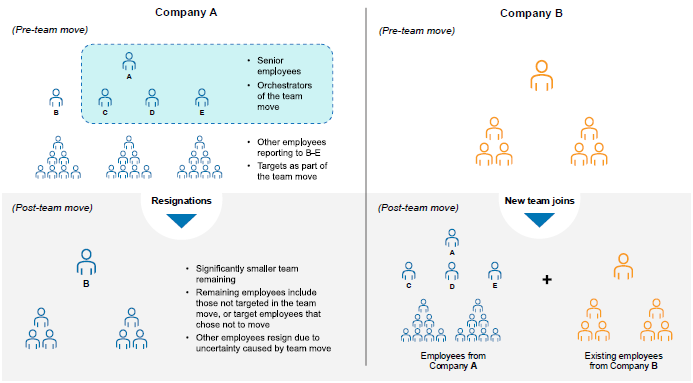
A typical raid generally involves the following steps: a senior employee (Employee A), such as a department head, resigns from Company A to join Company B. While still at Company A, or after they have joined Company B, Employee A entices other employees (Employees C-E), who typically manage teams, to resign and join them at Company B. These employees are often viewed as “recruiting sergeants.” While still employed at Company A, the recruiting sergeants persuade members of their teams to resign and join them at Company B. Employees then resign en masse, usually on the same day or within the space of a few weeks. Company B is a competitor of Company A. They may already have an existing team which the departing employees join, or the departing employees may join to set up a new team within Company B.
What are the impacts on Company A?
The damage to Company A can be significant:
- Teams that have taken years to build may be decimated in a short amount of time;
- The firm may no longer be able to fulfil existing client obligations;
- Clients may leave resulting in lost revenue and profits; and
- Morale within the firm may be damaged.
What are the impacts on Company B?
On the other hand, Company B gains significant advantages at the expense of Company A:
- A ready-made, functional team that knows how to work together;
- Experienced individuals with industry experience and knowledge of the market;
- Saving significant time and effort in building a team with the associated experience/knowledge;
- Weakening of a competitor; and
- Ready-made client relationships and associated revenues.
While non-solicitation clauses may impose restrictions on departed employees from using client relationships, in our experience, we generally see that clients also move with departed employees, the legality of which is often a contentious point in litigation. By breaching covenants, the departing employees and their new employers gain a competitive head start.
Springboard injunctions
In the English High Court, a common remedy against breaches of restrictive covenants is a springboard injunction. This type of injunction aims to cancel out the head start gained by the wrongdoer.
Courts refer to the American Cynamid test when determining whether to grant a springboard injunction. Under the American Cynamid test, Courts should consider three factors:
- Is there a serious issue to be tried;
- The adequacy of damages; and
- The balance of convenience between parties.
Courts may also refer to the Lansing Linde test, which sets a higher bar. It considers whether there is a serious issue to be tried, as well as how likely the claimant is to succeed at trial.
While springboard injunctions were originally used in cases of former employees taking and using confidential information, the landmark UBS v. Vestra case in 2008 widened the scope of springboard injunctions to include employee raiding and provided oft-cited guidance in subsequent employee raiding cases.
Springboard injunctions in the UK High Court from 2009 to 2025
In researching this piece, we have identified that there have been approximately 50 applications for springboard injunctions in the UK High Court since UBS v. Vestra. Of these, we determined at least 14 cases are related to team moves. The chart below summarises the number of springboard injunction applications per year, and of those injunctions, the number of cases where team moves were a key issue in the dispute:
Figure 2: Distribution of springboard injunction applications between team move cases and non-team move cases
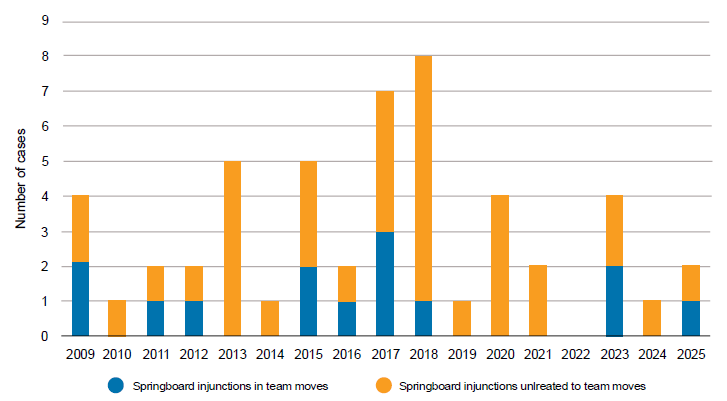
Overall, there is no clear trend in the number of springboard injunctions associated with team moves since 2009; some years have seen a handful of applications, whereas other years have recorded none related to team moves.
Springboard injunctions in team move cases in the UK High Court from 2009 to 2025
However, when examining the number of team move cases alongside the instances in which the claimant sought a springboard injunction in connection with team moves, springboard injunctions were requested in the majority of cases, as illustrated in the figure below:
Figure 3: Distribution of team move cases including/excluding springboard injunction applications
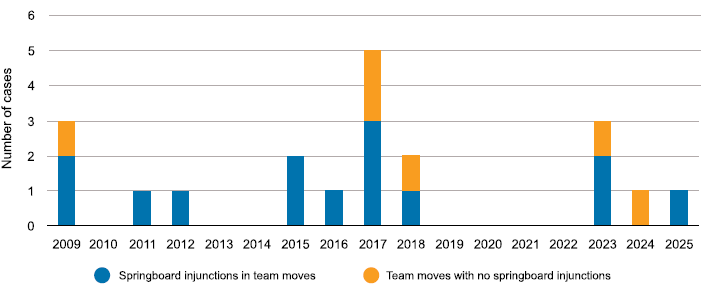
Of the 14 team move cases identified involving springboard injunctions, Claimants were successful in obtaining some form of springboard relief with respect to the enforcement of non-poaching covenants in the majority of cases. This was commonly a ban on Defendants from hiring from their prior firms for a period of time. Of the applications that were not successful, Claimants usually failed due to the covenants being too broad in scope, or the Judge deemed the team move to be commercially legitimate.
Was there a quiet period between 2019-2022?
In the figure above, there appears to be gap between 2019-2022, where there were no unlawful team moves or springboard injunctions relating to team moves. This may have been a result of COVID-19, rather than a fundamental change in the employee raiding landscape in the UK. Many firms froze hiring, especially during the start of the pandemic. It therefore logically follows that there would be a lower likelihood of team moves happening during this period. Further, in 2023, two of the three identified team moves included an application for a springboard injunction, suggesting that Claimants continue to view springboard injunctions as a useful tool in such disputes.
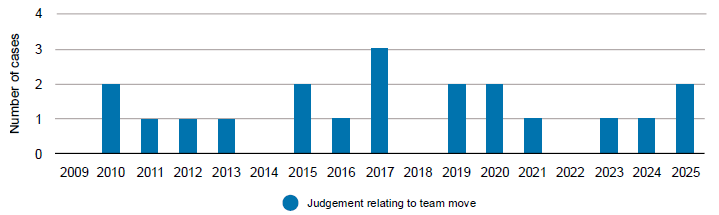
The springboard injunction may only be the first step in a protracted dispute. While 2019-2022 may have been quiet years in terms of applications for springboard injunctions, the number of court judgments relating to team moves shows a different picture, as shown in the figure below:
Figure 4: Judgements issued per year relating to team move cases
Cross-border litigation
While cross-border team moves are not new, cross-border litigation appears to be increasingly common in employee poaching cases. This adds complexities from the claimant’s perspective, including:
- Establishing a link between UK-based Defendants and departed employees in overseas locations;
- Evidence is likely more time consuming to gather and local laws could potentially restrict access to data;
- Employment contracts may differ across jurisdictions; and
- Parallel proceedings may be needed across multiple jurisdictions.
Despite these added complexities, Claimants can and still do apply for springboard injunctions.
What other issues are at play in team moves?
Non-poaching clauses are never the sole issue in team move cases. While every team move case is different, there are several causes of action that frequently crop up from the defendant’s perspective. Team moves involve planning and coordination. It can take several months before the departing employees resign, and activities generally occur while these individuals are still employed by Company A, with such behaviour viewed as breaches of good faith and fidelity. For senior employees, there are likely to be breaches of fiduciary duties too. Defendants may also claim for breach of contract and unlawful conspiracy.
In many cases, there is also an intellectual property element. Defendants are usually accused of obtaining and/or misusing confidential information, such as information relating to staff performance (i.e. key revenue earners) or client lists for the benefit of their new employers. Individual Defendants may also be accused of breaking other restrictive covenants, particularly non-solicitation clauses.
Settlement or trial?
Based on publicly available information, only a small proportion of cases go to trial, of which an even smaller subset addresses the issue of damages. Potential damages remedies depend on the causes of action, but in general terms, fall into three buckets:
- The first relates to additional costs incurred in order to stem further resignations. This includes retention payments, signing-on bonuses, and salary increases that would not normally be granted (either as an additional financial incentive or at rates higher than Company A would pay under normal circumstances). It may also include recruitment expenses incurred in new hires to replace the departing employees.
- The second bucket of damages are gain-based damages against Defendants. This includes clawbacks of payments made by Company A to individual Defendants (i.e., Employees A, C-E in the illustrative example above) while still employed by Company A, such as bonus payments or part of a Defendant’s salary. It can also include an account of Company B’s profits that they were able to generate as a result of wrongdoing relating to the team move.
- The third bucket relates to client losses, such as lost revenue and profits, due to clients moving their business alongside the Defendants. Claimants may also claim loss of business value as an alternative to lost profits. In terms of damages, this third bucket likely carries the most value but is also the most difficult to quantify.
Settlement appears to be the most common outcome in some of the larger employee raiding cases, such as UBS v. Vestra, Tullett Prebon v. BGC Brokers and Guy Carpenter v Howden. Settlement amounts are not always disclosed, but can be significant, particularly those involving litigation in multiple jurisdictions – Tullett Prebon and BGC Brokers collectively settled all employee raiding related litigation for $100 million in 2015.
How CRA helps clients get ahead of team move risks
Whether applying for a springboard injunction, assessing damages at trial, or negotiating settlement terms, CRA assists clients at all stages of the process.
Given the finite nature of non-poaching clauses, timing is critical when applying for a springboard injunction. If, by the time a claimant applies for a springboard injunction, most of the non-poaching period has lapsed, then Courts are unlikely to grant an injunction. A key element from the claimant’s perspective is to present evidence that indicates that employees were poached rather than left at their own accord. However, evidence is likely both voluminous and qualitative.
By employing advanced data analytics, we can efficiently get to the heart of what information is critical for a claimant’s case. We can analyse call or message volumes between individuals to identify patterns in communication, establish key dates or time periods, as well as identify the key individuals involved, and potentially identify other employees who might be at risk of resigning. Combined with strategic keyword searches, we can piece together a detailed timeline to understand how the raid was conducted.
Social media analytics can also be a powerful tool in discovering the extent of a raid. As an example, we used social media analytics to assist Claimants in an ongoing, live raid. We identified social media posts made by employees moving from Company A to Company B, prior to them officially handing in their resignations. We also identified social media posts that implicated Company B as being complicit in the raid.
Beyond the injunction stage, we have also acted for both Claimants and Defendants in settlement discussions, and as quantum experts in legal proceedings. Depending on the complexity of the raid, our experts can assess potential damages arising from breach of contract claims to theft of confidential information or trade secrets.