
A closer look at recent regulatory actions and labor market evidence shows that only careful, theory‑driven economic analysis can reveal the true competitive effects of NCAs in healthcare.
The Federal Trade Commission (FTC), Department of Justice (DOJ), and state regulators have publicly stated that non-compete agreements (NCAs) are an enforcement priority due to their potential anticompetitive effects in labor and product markets.
Recent enforcement initiatives have zeroed in on the healthcare industry, with the FTC issuing letters to several major firms in the industry, urging them to ensure their NCAs are procompetitive and appropriately scoped, and multiple states adding or expanding restrictions on NCA usage. For example, Texas’s SB 1318 law went into effect in September 2025, introducing geographical and temporal limits on NCAs and codifying buyouts, among other changes.
This article will explore core insights regarding NCAs in healthcare:
- Labor economics theory shows NCAs can have both pro- and anti-competitive effects. Properly structured NCAs may encourage employers to invest in training and capital and help align the incentives of employees and employers, benefiting everybody.
- The impact of NCAs on healthcare can’t be assessed using simple and aggregate statistics. Descriptive data alone can’t show whether non-competes have pro- or anti-competitive effects. Rigorous, theory‑driven economic analysis is essential to understand their true effects.
- Both NCA prevalence and their costs and benefits vary across types of workers. The agreements are more common among highly skilled healthcare professionals like physicians, where the potential benefits of aligning incentives of employers and employees are large and accrue to both parties, as predicted by labor economics.
Headlines don’t tell the full story
While descriptive data on NCA prevalence and news stories on NCAs’ alleged negative economic impact have fueled public and regulatory concern, such patterns rarely reveal the underlying economic forces shaping their use or impact.
Instead, the commonly alleged anticompetitive effects of NCAs, e.g., worker mobility restrictions, foreclosed professional advancement opportunities, and reduced wage-bargaining leverage, often arise from a unique combination of circumstances that do not necessarily reflect NCA prevalence in the economy.
Descriptive statistics and anecdotes in labor markets where remote work, AI adoption, and diverse and complex worker incentives are common, can obscure more than they reveal. In this evolving landscape, evaluations based on rigorous econometric analysis guided by sound labor economic models are essential for disentangling opposing explanations about both the competitive impact of NCAs, and arguments regarding the business necessity of such agreements.
The role of labor economics in evaluating non-competes
Labor economics provides a rigorous framework for evaluating the emergence, prevalence, and characteristics of NCAs, including whether these arrangements are mutually beneficial for workers and firms by aligning organizational and individual incentives, potentially enhancing productivity and competition in labor and product markets.
Labor economic research has shown that properly scoped NCAs could be a key procompetitive mechanism within the labor market for encouraging employers to invest more in their workers and the business (through capital investments, training, disclosing proprietary information and trade secrets, and sharing client relationships) by ensuring employers and workers share the benefits of such investments while keeping key information safe from competitors. Improved operations benefit not only employers and employees, but also customers.
Thorough economic and statistical analyses are required to evaluate NCAs’ potential impact
The theoretical pro- and anti-competitive effects of NCAs are well understood,1 but few empirical studies have examined NCAs’ effects on employment and product market outcomes. Furthermore, the few studies on this topic suffer from severe data and econometric limitations that restrict the interpretation and applicability of the findings,2 including the studies involving occupations in the healthcare industry.3 Careful analyses that account for the peculiarities of labor markets and the healthcare industry are central to evaluating NCAs’ impact.
Furthermore, cursory review of the patterns in the data can be misleading. Descriptive differences alone cannot be interpreted as causal evidence of either restricted mobility or improved working conditions; without deeper analysis, the same data can support contradictory narratives.
Source: Federal Reserve Board’s SHED Survey, 2022-2024 rounds
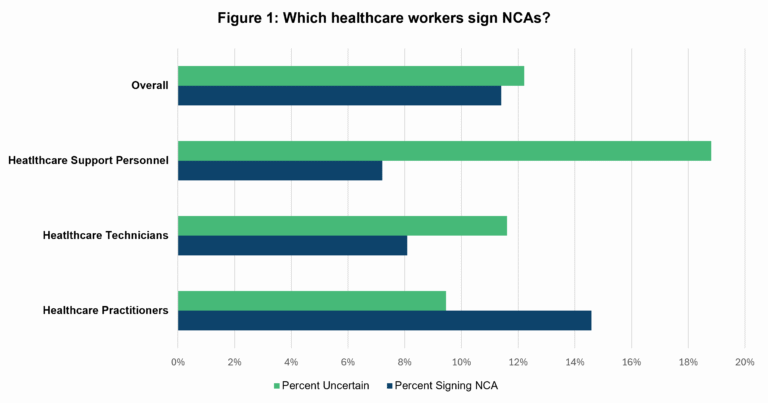
For example, recent data from the Federal Reserve Board’s Survey of Household Economics and Decisionmaking (SHED) shows the prevalence of NCAs across type of healthcare role. Figure 1 shows the percentage of employees who are aware of having a signed NCA, by role. About 12% of workers across these groups are unsure of whether they have signed one.
Source: Federal Reserve Board’s SHED Survey, 2022-2024 rounds
NCAs are more common (and better understood) among highly educated healthcare workers
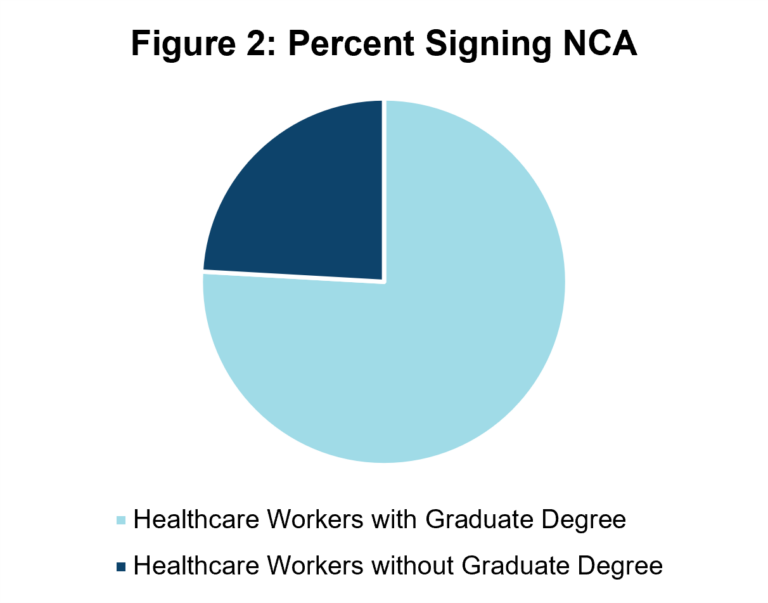
While this may seem to imply that NCAs are used across all types of healthcare roles, further assessing the data based on formal educational attainment reveals that about 22% of healthcare workers with a graduate degree have signed an NCA compared to just 7% of those without a graduate degree (see Figure 2).
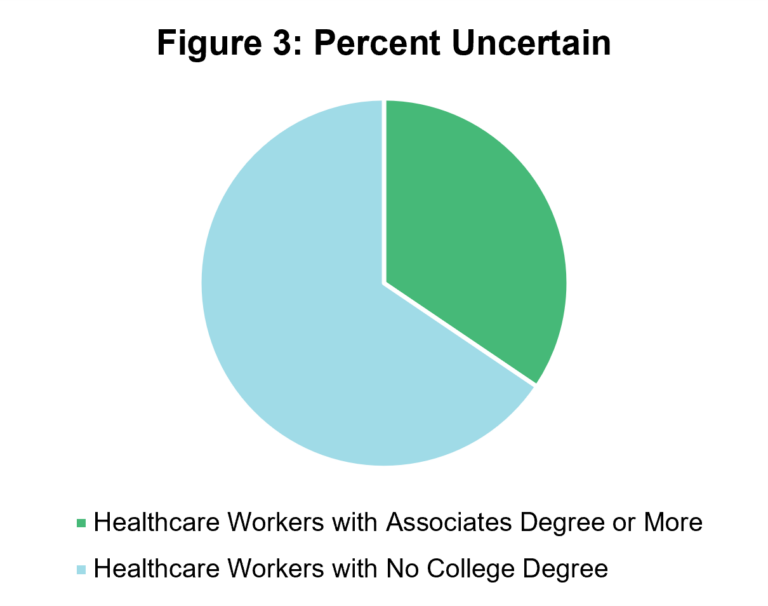
Those with less formal education are also less likely to know whether they have signed an NCA (see Figure 3).
These findings are in line with economic theory and the business rationale for NCAs in the healthcare industry: namely, highly skilled and experienced workers dominate occupations requiring access to sensitive information and major capital investments.
Source: Federal Reserve Board’s SHED, 2022-2024 rounds
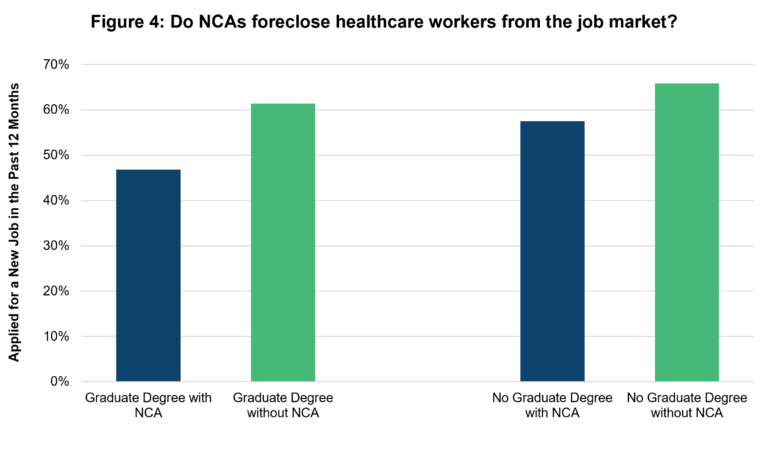
Drilling down even further, Figure 4 shows that 47% of healthcare workers with graduate degrees and a signed NCA applied for a new job in the past 12 months, compared to 61% of healthcare workers with graduate degrees and no signed NCA.
These figures could support two competing narratives: one suggesting that NCAs restrict access to jobs, and another indicating that NCAs positively impact working conditions such that workers are more likely to remain in their roles by choice. Because descriptive statistics cannot distinguish between workers’ choices, incentives, and constraints, rigorous econometric analysis and factual review tailored to the occupations and labor markets at issue are required to determine which mechanisms are actually at work.
Impacts of healthcare NCAs according to economic research
Careful economic research can empirically separate the impacts of NCAs on product and labor markets.
Some notable studies indicate that industry and occupation have large impacts on the theoretical costs and benefits of NCAs. In the healthcare industry, NCAs are common among physicians and serve to incentivize capital investments and protect sensitive information, such as patient lists. In particular:
- Primary care physicians: This study found that NCAs increase returns to tenure, likely by converting patient relationships into firm-specific capital, encouraging internal-firm referrals, and tying physician earnings more closely to individual output rather than fixed salaries. The authors conclude that pairing NCAs with incentive-based pay can offset reduced worker bargaining power, and more broadly, NCAs boost earnings growth and investment in service firms.
- Ambulatory surgery centers: This study used comprehensive Medicare data and found that when physicians are vested in the success of Ambulatory Surgery Centers (ASCs), Medicare spending decreased without negative patient outcomes or a shift to suboptimal procedures. NCA bans could weaken the incentives to create arrangements in which physicians invest in ASCs.
CRA’s experienced labor economists provide insight that goes beyond simply observing data trends
As the discussion above highlights, the use of NCAs reflects complex interactions between labor market conditions and idiosyncratic circumstances. CRA’s labor economists and academic affiliates have extensive experience in the application of labor economic theory and statistical techniques to the analysis of labor markets.
Our extensive experience in the analysis of labor market trends, including the assessment and definition of relevant markets, combined with labor economics evaluations of NCA terms and conditions, provides a robust framework for understanding when non-competes may be justified and where potential risks may arise, either when NCAs have been challenged in court, or when their adoption is being considered.
The authors would like to thank Zijing He for her invaluable contributions in the preparation of this article.
1 Manne, Geoffrey A., et al. Labor Monopsony and Antitrust Enforcement: A Distorting Mirror. De Paul Law Review, Summer 2025, Vol. 74, Issue 4, 1119 – 1173.
2 McAdams, John M. Non-Compete Agreements: A Review of the Literature. SSRN Working Paper. https://dx.doi.org/10.2139/ssrn.3513639
3 Gilman, Daniel J., JD, Ph.D. A Competition Perspective on Physician Non-Compete Agreements. INQUIRY: The Journal of Health Care Organization, Provision, and Financing, Vol 61: 1-9.