Introduction
The Accord Cadre, signed in 2021 by Leem, representative of the French pharmaceutical industry, and the Comité économique des produits de santé (CEPS), established the principles that govern pricing negotiations, lifecycle pricing, and interactions between manufacturers and public authorities. Whilst a new agreement was initially planned for 2025, political instability led to two extensions of the current agreement. The new agreement was finally signed in September 2026 with one key principle: zero missed opportunities for patients.
Key takeaways:
|
A more favourable environment for innovation at launch
While medicine prices have been historically linked to the level of clinical benefit reflected through the ASMR rating, the 2026 Accord Cadre now introduces greater flexibility in how this value can be translated into price. Specifically, the agreement introduces the concept of a launch price, which is defined as a temporary pricing advantage relative to the reference comparator. Under the agreement, CEPS may grant a launch price to medicines achieving an ASMR I to III rating, as well as certain ASMR IV medicines in therapeutic areas where no new medicine has been reimbursed for “many years.” Eligibility for a launch price also varies based on clinical development activity in France, with a target of at least 5% of trial recruitment centres located in France, as well as prior participation in the early access pathway (Article 3).
The increased flexibility is not limited to highly innovative medicines, as the Accord Cadre also softens price constraints reserved for ASMR V products. While manufacturers are still expected to consider the lowest-cost comparator during negotiations, CEPS may now negotiate gross-to-net discounts in certain circumstances. This is particularly relevant for medicines that generate meaningful savings elsewhere in the healthcare system or products supported by substantial European manufacturing activity. Discount levels may be tailored based on competitive intensity, route of administration, and the loss-of-exclusivity (LoE) status of comparator products (Article 2).
Comparator selection may become the defining pricing discussion
For products with an ASMR I to IV rating, the Accord Cadre now explicitly allows consideration of the most recent market entrant as a reference comparator, provided it demonstrates a similar ASMR rating in a similar patient population, and a price discount is applied (Article 2).
The framework also broadens the definition of price comparators when no direct clinical comparator exists. In addition to products sharing a similar therapeutic area, patient population, level of clinical benefit, or positioning, price benchmarks may now extend to medicines used in earlier treatment lines. Furthermore, unregulated market prices (e.g., free market, intra-DRG, European purchasing) and certain off-label alternatives may be considered in specific situations (Article 1).
Off-label medicines and products not commonly used cannot be referenced as a price comparator (as laid out in the 2021 Accord Cadre). Off-patent medicines (generics, biosimilars, or hybrids) are also excluded as comparators once an equivalent product is marketed, specifically for medicines with an ASMR I – III, and those with an ASMR IV in an indication for which no new medicine has been approved for reimbursement for many years (Article 1).
Greater recognition of healthcare system value
Under the revised framework, CEPS may consider direct medical cost offsets and healthcare resource savings when determining pricing conditions, provided these benefits are substantial, robustly demonstrated, and validated by HAS. Examples could include reductions in hospitalisations, healthcare resource utilisation, or other direct medical costs associated with patient management. Nonetheless, manufacturers benefiting from these provisions may be required to generate confirmatory real-world evidence, and failure to demonstrate the anticipated savings could result in repayment mechanisms (Article 4).
Formalised price assessment of high-cost combination therapies
The Accord Cadre introduces greater transparency on the assessment of high-cost combination regimens by acknowledging that the economic value of a combination should be assessed relative to the net cost of the relevant comparator regimen. Where the contribution of each combination component is not clearly demonstrated, the overall value of the regimen may be divided equally between the products (Article 5).
Greater lifecycle management price pressure
Initial reassessments will continue to occur approximately 3-4 years after launch, defined as 6 months after the first CEPS evaluation – this may be extended to 5 years for innovative medicines. The new Accord Cadre now introduces subsequent reviews every 2 years thereafter with several factors informing these reassessments, including competitive dynamics, real-world utilisation, changes in clinical practice, comparator pricing, budget impact, RWE showing cost savings, and supply security considerations. Additionally, any indication expansion with >10% increase in patient population will be automatically subject to a price renegotiation (Article 11).
The Accord Cadre also introduces the possibility for CEPS to grant price increases for certain mature products where continued commercialisation may no longer be economically sustainable and where there is a risk of market withdrawal (e.g., post-LoE). In return, manufacturers must commit to maintaining appropriate supply to the French market (Article 11).
A more predictable framework for LoE
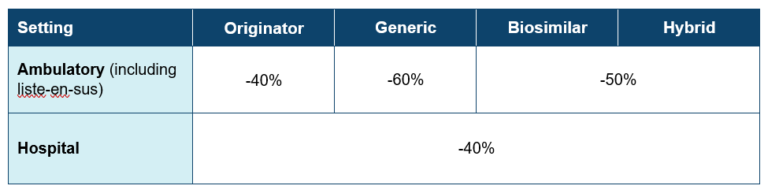
Articles 11 and 12 of the Accord Cadre introduce revised discounts for originators post-LoE and their biosimilars, generics, and hybrid versions. Under the new framework, the list price will be aligned with the product’s net price by the time of patent expiry and typically will be subject to a minimum 10% additional reduction at LoE. Once a generic, biosimilar or hybrid enters the market, this 10% reduction is complemented so that the originator reaches a total discount of 40% relative to its pre-LoE price. Expected discounts for both originators and entrants are summarised in the table below.
Who wins in all of this?
The changes introduced by the new Accord Cadre bring several benefits for manufacturers, with greater flexibility at launch through the introduction of the launch price concept, broader comparator options, and greater opportunities to demonstrate value beyond traditional clinical outcomes. This reflects willingness from health authorities to better recognise and reward innovation and supports a wider policy objective of improving patient access and strengthening France’s attractiveness for pharmaceutical research, development, and investment, building on measures introduced by the recent Social Security Financing Law (PLFSS) such as the direct market access scheme.
The agreement also arrives at a time of growing international scrutiny of ex-US drug prices, particularly following the emergence of the US Most Favoured Nation (MFN) order. While the Accord Cadre introduces several mechanisms aimed at tighter expenditure control, it also provides manufacturers with additional tools to preserve value, such as negotiated gross-to-net discounts for certain ASMR V products and greater recognition of healthcare system savings. As such, the agreement may be seen as an effort to balance healthcare sustainability with the need to preserve patient access to innovation.
However, many of the provisions introduced are accompanied by greater payer requirements throughout the product lifecycle. Manufacturers will face more structured reassessments, stronger expectations around real-world evidence generation, explicit triggers for price renegotiation following indication expansions, increased requirements of French clinical development activity, and a more clearly defined LoE framework. As a result, pricing success in France may increasingly depend not only on demonstrating value at launch, but also on sustaining value over time through evidence generation, lifecycle management, and strategic portfolio planning.